Welcome to Diana's Blog

I blog about anything that interests me - my local area, things I've seen or heard on the news, politics and human rights, gardening, arts and crafts, poetry, photographs and general advice.

And, when you've finished reading, don't forget to leave a comment - I love hearing from people


Showing posts with label Local History. Show all posts

Monday, 8 August 2011

Riots in Tottenham, in the London Borough of Haringey: See the photo link:

Tottenham Riots, London 5th August 2011

IMG_9756 | Flickr - Photo Sharing!
I'd like to post the actual photo on this page, but I can't because it's copyrighted, but well worth a look.

Such a beautiful Art Deco building with a carpet shop below and flats above wiped off the face of Tottenham High Road. People made homeless, jobs lost, and for what? - What idiots destroy their own community? I don't think this is anything to do with Mark Duggan's shooting - why would you burn your own shopping centre because you're cross? What would it prove?

Am I missing something?

I've lived in Haringey for 50 years, and this makes me feel very sad, because so much effort and money has gone into regeneration of the area since the Broadwater Farm incident 25 years ago, when an unarmed policeman was hacked to death with machetes during a riot. At that time, rioting got out of hand because many of the local youth were angered by the local police policy of "Stop and Search", when the police had a legal right to stop and search anyone they suspected of committing an offence. And the black community in Tottenham felt that they were being unjustly targetted.

After that, a huge effort was made to change policing, to employ more black police, have local community liaison committees and so forth; money was poured in to the bleak concrete jungle which was Broadwater Farm Estate, and much was done to make it more of a supportive community, with a community centre, and planting of trees and other cosmetic effects to make the occupants feel less alienated from society.

For years Haringey has had one of the highest council taxes in Britain, and this was to improve the lives of those living in the poorest part of the Borough. I believed in this Socialist principle, so didn't really resent paying high local taxes (just some of the wastefulness that went with it!).

Schools were improved, the whole Borough of Haringey was "greened up", with tree and garden planting, cleaning up areas where there had been fly-tipping, better street cleaning, better street lighting, improved, cleaner local parks, better sports facilities and good library facilities. There were "inclusive" policies, and positive discrimination in employment. There is a huge ethnic mix in Haringey, with something in excess of 100 languages spoken by children in the local schools. Official Local Government information leaflets are normally distributed in about 10 different languages, to help people feel loved and wanted. Many people did feel that things had improved considerably, but the youth unemployment and crime rate, much of it drug-related, remained high.

So why arson - one of the most dangerous offences in the book? In a crowded city like London, it can wreak havoc - and that's why it is a very serious crime - think "Fire of London".

I, for one, certainly don't think pouring a lot more money into Haringey is going to solve this one, because it doesn't seem to have helped much up to now. It seems to me that the people who did this, probably thoughtless youths who don't think beyond their own noses (and certainly not about actions having consequences), should now start to think about pulling themselves up by their bootlaces, like other second-generation immigrant populations before them, instead of behaving badly and then whining about their rights and lack of opportunities.

Tuesday, 22 December 2009

Poem: The Fire at Alexandra Palace


I saw the Palace burning,
Burning, burning,
I saw the Palace burning
Lighting up the sky 
 
A smoke-grey finger swirling
Swirling, swirling
Just glimpsed between the houses
Pointing to the sky

Then crowds of people surging
Surging, surging
To see the flames go licking
Up towards the sky

And scarlet engines racing
Racing, racing
With firebells loudly ringing,
Their clanging filled the sky

Like ants appeared the firemen,
Firemen, firemen
Swarming round the building
Dark forms against the sky

And children rushing forward,
Forward, forward
While policemen barred their progress
As they looked up to the sky

And beams and ashes falling
Falling, falling
Made everyone step backwards
As they watched the darkening sky

And now the wind was blowing
Blowing, blowing
And flames and smoke now billowed
In their race to meet the sky

And fiercely sprayed the water,
Water, water
As the firemen turned their hoses
Up towards the sky

Then home we turned, exhausted,
Exhausted, exhausted
The fire raged ever fiercer
And lit the dusky sky

The blaze was like a beacon
Beacon, beacon
All London saw it burning
Till dawn suffused the sky
       Then Lloyds paid out eight million                                   £8,000,000
       Eight million, eight million
       And the Owners were so happy                                     
       Their insurance was sky high                                   

Diana Grant


                 (c)

Alexandra Palace Fire 10th July 1980

Who would have thought  it was nearly 30 years ago?

 My son and I were sitting on our front wall just beyond Alexandra Park Road, chatting. I looked up and noticed a small dark smoke cloud drifting up above the rooftops. I pointed it out to Charlie, and although we couldn’t see the source, we both agreed it was probably the Palace, and we ran out to see.

I had previously seen Blandford House burn down in the Palace grounds only a few years previously. Curious, we jumped into the car, and drove part of the way up the hill where it became obvious that it was indeed the Palace on Fire. We left the car a safe distance away and went the rest of the way by foot.


We were among the first to arrive even before
 the fire engines were there.


We stood on grass by the steep slope, very close to the fire, and Charlie was so excited he wanted to run right up the slope to get closer still, and I had to haul him back as I was frightened he might be hit by falling timber or hamper the firemen, who were just beginning to arrive.


We moved back and they seemed like little ants rushing about. At that stage the fire had not really taken hold and they seemed to be getting it under control.

We could see the big window at the front of the Great Hall lit up with great orange flames licking out of it. At first it was hard to distinguish the flames from the yellow-red brickwork, but the intense moving colours soon drew our eyes.


There was scaffolding round the front of the building where workmen had been renovating that area.


I knew the Palace and Park well, from going to the Panorama Bar, courting there in my youth, working, taking my children to the ice rink, and generally roaming around. I used to work in the BBC Television Newsroom in the part where the BBC Television Tower is.


During the afternoon the flames seemed to have died down a bit, but later that evening I happened to visit someone who lived high up in a flat in Shepherd’s Hill, Highgate, with a clear view of the Palace, which was again completely engulfed in flames, and I believe it burned all night.

Oh, and by the way, there had been local wrangles all the previous year about who was to take over the Palace, and who was to pay for substantial upgrading and renovation.  Then came the fire, apparently started from an electrical fault whilst the renovations were being carried out, and there was a £3million insurance pay-out.  Was that handy or what?  Every cloud has a silver lining and this was quite a large cloud. Curious nimbus.

Here is a LINK to the BBC Television News Video Report in 1980.

And here is a LINK to the fire at St Andrew's Church, Alexandra Park Road, N10 in 2009.

And a LINK to the fire at Blandford Hall, Alexandra Park  on July 17th 1971.


And a LINK to a very detailed article dated 1993 about the history of the great organ at Alexandra Palace.

                          (Acknowledgement to I Barwell for the picture on the right)


And this LINK is to my POEM "The Fire at Alexandra Palace"

Saturday, 12 December 2009

Copenhagen - Candlelit Vigil Across the World

       Copenhagen


Let your candles burn tonight
The world needs our support


Let your candles shine so bright
Our leaders need support


It’s our job to spread the light
The world’s poor need support


Keep your candles glowing white
Our children need support

Add your voice to the climate fight
Our wildlife needs support


Hope and pray with all your might
The world will give support


As people round the world unite
And join in their support

Hold the ideal in your sight
Hold your intention really tight
And as our candles burn tonight
Light up the world with gentle light


.....Copenhagen


Wendy Beauchamp-Ward             12 December 2009

Tuesday, 27 October 2009

Do you know what Mennonites are?

Somewhere at the top of Shepherds Hill in Highgate, London, there is an enormous old red brick Victorian manor house.  I had reason to go there to collect something, and discovered that it was the  Library of the London Mennonite Centre.  I was curious to find out what this organization was, as I had never heard of it.  I tried the usual Wiki search, but it was a bit too piecemeal for me so I tried another website, gotquestions.org, which seems to be a website about all things biblical. I have summarised what they say :

"Question: "Who are the Mennonites and what are their beliefs?
 Answer: The Mennonites are a group of Anabaptist (opposed to infant baptism) denominations      named after and influenced by the teachings and tradition of Menno Simons (1496-1561). They are  committed to nonviolence, nonresistance, and pacifism.

"Mennonite congregations worldwide embody the full scope of Mennonite practice from old-fashioned “plain” people to those who are indistinguishable in dress and appearance from the general population.

Early Mennonites in Europe were good farmers and were invited to take over poor soils and enrich them through hard work and good sense. Often the governing bodies would take back the land and force the Mennonites to move on since they would offer no resistance. So the migration to America started and they were welcomed by the Colonists.

There are many schisms, which actually started in Europe in the 1600s and continued after the immigration to America. Many of these churches were formed as a response to deep disagreements about theology, doctrine, and church discipline. Mennonite theology emphasizes the teachings of Jesus as recorded in the New Testament. Their core beliefs deriving from Anabaptist traditions are: the authority of Scripture and the Holy Spirit; salvation through conversion by the Spirit of God; believer’s baptism by sprinkling; discipline in the church (including shunning in some congregations); and the Lord’s Supper as a memorial rather than as a sacrament or Christian rite.

There is a wide scope of worship, doctrine and traditions among Mennonites today. Old Order Mennonites use horse and buggy for transportation and speak Pennsylvania Dutch (similar to German). They refuse to participate in politics and other so-called “sins of the world.” Most Old Order groups also school their children in church-operated schools. Conservative Mennonites maintain conservative dress but accept most other technology. They are not a unified group and are divided into various independent conferences. Moderate Mennonites differ very little from other conservative evangelical protestant congregations. There is no special form of dress and no restrictions on use of technology. They emphasize peace, community and service.

Another group of Mennonites have established their own colleges and universities and have taken a step away from strict Bible teaching. They ordain women pastors, embrace homosexual unions, and practice a liberal agenda, focusing on peace studies and social justice issues, good works and service to others.

There are many varieties of Mennonites. Some  are more evangelical than others; some are focused on Bible study and prayer; others re carefully maintain the works-based tradition set out by their ancestors; and, some  have left the faith of their fathers and focus instead on current social issues."


Wednesday, 27 May 2009

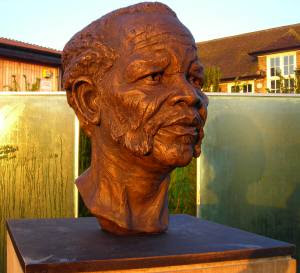
Memorial to Oliver Tambo in Durnsford Road Park, Muswell Hill, London

Oliver Tambo lived with his family in Muswell Hill for many years during his exile from South Africa during the apartheid years.

Here are some photographs of his bust in the park and a few words about him. I got up very early one November morning to get the most spectacular photos I could, just before and after the sun rose as the colour of the bronze changed from dull brown to shimmering gold; and then, in addition, I couldn't resist showing a very chilly Oliver in the snow.


November - a minute before sunrise


The minute of sunrise November Dawn


A cold winter's day

Oliver Tambo, co-founder of modern South Africa, was instrumental in bringing down the apartheid regime from a house in Muswell Hill, North London. He and his former home were recognised in October 2007, when his bust, by the late Ian Walters (who also sculpted the statue of Nelson Mandela in Parliament Square) was unveiled in Durnsford Road Park, and a blue commemoration plaque was placed on his old house.

The three-storey house on the corner of Alexandra Park Road was once, in effect, the home of a government in exile and the children of one of the 20th century’s greatest statesmen used to play in the nearby park where now there is a memorial site with the bust of Oliver Tambo, the co-founder of the modern South African state, who came to London penniless and unknown in 1960, with the police on his tail. His wife Adelaide and young children were smuggled out to join him. The family could not have afforded this large house had it not been for political sympathisers raising the money to provide what was in effect the unofficial London headquarters of the African National Congress.

Oliver Tambo and Nelson Mandela together led their people to freedom. While Mandela was in prison for 27 years for political offences under the old apartheid regime, Tambo was travelling the world as a head of a quasi government in exile. In Muswell Hill a lot of people had never heard of him, and he was remembered by many locally, if at all, as the quietly spoken husband of an NHS nurse who lived with her three children in the big house. Unknown to them, it was a house where the phone was tapped and which attracted many visits from those involved in the anti-apartheid movement.

Nelson Mandela, a fellow lawyer and activist, visited him briefly in 1962. At that time Mandela was unknown, but by the time of Mandela’s second visit just after his release from 27 years’ imprisonment, they were both world leaders.

Over the years Tambo lobbied for international recognition, establishing ANC missions which were shadow embassies for a future South Africa, in 27 countries. He also founded the military wing of the ANC. When the Portuguese empire came to an end in 1975 Tambo moved his guerrillas out of training camps in Tanzania and Zambia into Angola near the South African border as a warning that the ANC were prepared to use force unless the apartheid system was dismantled peacefully. By the mid 1980’s, governments across Europe were in contact with him. The British Thatcher government, however, still considered the ANC to be a terrorist organisation, but eventually at an unofficial meeting with Sir Geoffrey Howe, the foreign secretary, Tambo was able to convince Howe of his serious statesmanlike qualities.

In 1989 Tambo suffered a stroke and, seriously ill, he was warned not to overwork. He returned to South Africa for the ANC’S first legal national conference there, in July 1991 and was elected as its National Chairman, but he died less than two years later barely having time to enjoy the fruits of his hard thirty-year struggle for freedom from apartheid in South Africa
[The source of most of this information is an article by Andy McSmith in The Independent 15 October 2007]